

Independent Women Business Owners in Israel During Periods of Economic Crisis
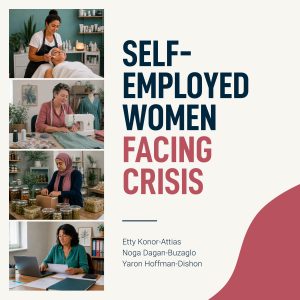
This study examines how women-owned small businesses in Israel have coped with economic crises, focusing on three major crisis periods in recent years: the COVID-19 crisis, the October 7th war, and the fighting between Israel and the Iran war of June 2025. The study is based on a survey conducted in 2025 among women who established or continued to operate small businesses after participating in business entrepreneurship training programs run by the Association for the Economic Empowerment of Women (EEW).
The businesses owned by the survey participants are mostly very small businesses, and most do not employ additional workers. These businesses tend to operate in fields such as grooming and cosmetics, food and cooking, personal coaching and training, design and art, and education and teaching. These fields rely heavily on direct contact with customers and in-person activity, making them especially vulnerable during periods of crisis and activity restrictions.
The study’s findings indicate that during crisis periods, most business owners experienced significant damage to their business activity and income. Between 60% and 70% of respondents reported a decline in business income during the crisis periods examined, and in many cases business activity was also temporarily halted. Alongside the economic damage, many of the women described feelings of ongoing uncertainty, difficulty planning ahead, and psychological burnout stemming from the need to combine business management with family responsibilities during emergencies.
The study also indicates that some business owners managed to develop various adaptation strategies to cope with the damage to business activity. Among other things, it emerged that some women moved to online activity, adapted their products or services to new needs, or reached out to additional target audiences. However, only about half of business owners managed to make adaptations of this kind, partly due to a shortage of financial resources, professional knowledge, or appropriate business support.
A further finding of the study is that access to government assistance during crisis periods was limited for a significant portion of business owners. About 42%–43% of women whose businesses were harmed during the COVID-19 crisis or during the October 7th war did not apply for a government grant, or wanted to apply but did not know how. In addition, some women who did apply for a grant did not actually receive assistance. These figures point to a gap between government assistance tools and the ability of very small business owners to make use of them.
The study indicates that small businesses owned by women operate within a particularly vulnerable economic framework in times of crisis. A combination of the characteristics of micro-businesses, structural gender gaps, and assistance policy that is not fully suited to very small businesses increases the vulnerability of women business owners during emergencies.
Given the contribution of these businesses to household livelihoods and to the economic resilience of communities, it is important to develop public policy that recognizes their unique characteristics and provides tailored responses. Strengthening assistance mechanisms, improving access to information, and better adapting support tools to very small businesses may contribute to business owners’ ability to cope with future crises and to strengthening Israel’s economic and social resilience.
Based on the study’s findings, several key recommendations for public policy are proposed:
- Systematic collection and publication of data on small businesses in Israel, broken down by gender;
- Establishment of a fast and simple-to-operate compensation mechanism for small business owners in times of crisis;
- Adapting eligibility conditions for government grants to businesses with low turnover that do not employ workers;
- Expanding assistance mechanisms for training and support in online commerce and digital marketing;
- Developing frameworks for business networking and strengthening cooperation among small business owners.