


Menu

Adva Center

Information on Equality and Social Justice in Israel

Adva Center

Information on Equality and Social Justice in Israel

  • About
  • Publications
  • Courses and Lectures
  • In the Media
  • Contact Us
Donate Here Subscribe to our newsletter!
עבר العربية
Subscribe to our newsletter!
עבר العربية
Dates:
Search Options:
  • About
  • Publications
  • Courses and Lectures
  • In the Media
  • Contact Us
Donate Here
Advanced Search
Skip to content
  • Budget and Economy
  • Gender
  • Employment
  • Education
  • Health
  • Welfare and Housing
  • Local Authorities
  • Climate
  • October 7 War
Research

Israel: A Social Report 2026

The Serious Crisis of Mental Health Services in Israel

The Bottom 10 Percent Needs the Top 10 Percent: Social Welfare Services in Israel

A Military Budget for a Permanent War

Op-ed

One Fell Swoop

Dark Years for Israel: Comments on the Proposed National Budget for 2025

Everybody is Talking About the Cost of Living in Israel but Nobody is Doing Anything About It

Per Student Investment in Education in Israel is Lower than the Average among OECD Countries

Research

Self-Employed Women Facing Crisis

Israel: A Social Report 2026

Why Is Women’s Pay Lower Than Men’s? Infographic Presentation

Gender Lens Philanthropy: The Complete Guide to Promote Gender Equity through Strategic Philanthropy

Op-ed

The Threat to the Economic and Personal Security of Arab Women Wrought by the War

Sisterhood of Gun Violence: Women will Bear the Consequences of the Arming of the Israeli Civilian Population

In Times of Crisis, Women’s Employment is More Precarious than Men’s

How Adva Center Worked for Gender Budgeting in Israel – And What Still Needs to be Done

Video

Gender Mainstreaming Municipal Policy

Read the Post
Video

Gender Mainstreaming Municipal Policy

February 17, 2016

Three Examples for Gender Audit of Municipal Budgets

View

Research

Self-Employed Women Facing Crisis

Israel: A Social Report 2026

“You will need to work twice as hard”: From Higher Education to the Labor Market – The Trials and Tribulations of Ethiopian Israelis

Why Is Women’s Pay Lower Than Men’s? Infographic Presentation

Op-ed

Employment by the Hour is Harmful Employment

In Times of Crisis, Women’s Employment is More Precarious than Men’s

More Hi-Tech ? What Israel Really Needs is More Help-Tech

Research

Israel: A Social Report 2026

“You will need to work twice as hard”: From Higher Education to the Labor Market – The Trials and Tribulations of Ethiopian Israelis

Israel – A Social Report 2022: The Inequality Epidemic Still Rages

The Care Deficit: What it Means and How it Can be Reduced

Op-ed

Per Student Investment in Education in Israel is Lower than the Average among OECD Countries

Let Them Learn: It Is the Time for a “New Deal” in Higher Education

Research

Israel: A Social Report 2026

The Serious Crisis of Mental Health Services in Israel

Food Insecurity in Bedouin Villages Deprived of Recognition in the Negev Region of Israel

Budgeting Resilience Centers: Professional Decisions or Political Pressures?

Op-ed

In war as in peace, Arab Israeli physicians’ contribution to Israel is essential

More Hi-Tech ? What Israel Really Needs is More Help-Tech

Coronavirus Crisis: Cheers are not enough!

What Happened to 20% of Israel’s Citizens?

Research

Israel: A Social Report 2026

The Serious Crisis of Mental Health Services in Israel

The Poor Who Don’t Count: Poverty, Food Security and Economic Well-being among Asylum Seekers in Israel

Food Insecurity in Bedouin Villages Deprived of Recognition in the Negev Region of Israel

Op-ed

Proposed budget cuts will have an adverse effect on Arab youth

Lessons of the Covid-19 Epidemic Forgotten: Unrecognized Bedouin Villages in the Negev Face Hunger

More Hi-Tech ? What Israel Really Needs is More Help-Tech

As mental distress rises, health services are falling behind

Video

Online Event: Housing for All in Israel – What We Can Learn from Vienna?

Read the Post
Video

Online Event: Housing for All in Israel – What We Can Learn from Vienna?

Adva Center, The Van Leer Jerusalem Institute, April 25, 2022

Discussion on the possibility of implementing the policy of “housing for all” in Israel

View

Research

The Refiguring of Israel in the Wake of October 7, 2023

Numbers that Reveal Abandonment: Government Allocations to Local Governments in the “Gaza Envelope”

Central Government Subsidies of Municipal Budgets, 1997-2017

Inequality in Government Transfers to Municipalities, 1997-2016

Op-ed

What Happened to 20% of Israel’s Citizens?

The Quality of Municipal Officials Alone Does not Determine the Quality of Municipal Services

Video

Gender Mainstreaming Municipal Policy

Read the Post
Video

Gender Mainstreaming Municipal Policy

February 17, 2016

Three Examples for Gender Audit of Municipal Budgets

View

Research

Road Transport, Environment and Equity in Israel

cost of livingprivatizationOctober 7 warlabor rightsstate budget
Research

Israel: A Social Report 2026

Etty Konor-Attias, Noga Dagan-Buzaglo, Miri Endeweld Sabag, Shani Bar-On Maman, July 12, 2026
Share on FacebookShare on X (Twitter)Share on Email
Copy Link

After nearly three years of war, Israel remains in a state of ongoing emergency rather than returning to routine. Even during periods when the intensity of fighting eases, security uncertainty, evacuation, repeated rounds of reserve-duty call-ups, and the absence of a political horizon continue to shape civilian life and budgetary priorities. Alongside this, a civil struggle over the boundaries of democracy is underway. Within this reality, the socioeconomic question is pushed to the margins — precisely at a time when the need for strong public services and broad economic security has become more urgent.

Download the full report View previous publications

After nearly three years of war, Israel remains in a state of ongoing emergency rather than returning to routine. Even during periods when the intensity of fighting eases, security uncertainty, evacuation, repeated rounds of reserve-duty call-ups, and the absence of a political horizon continue to shape civilian life and budgetary priorities. Alongside this, a civil struggle over the boundaries of democracy is underway. Within this reality, the socioeconomic question is pushed to the margins — precisely at a time when the need for strong public services and broad economic security has become more urgent.

Even before the war, per-capita civilian spending in Israel was low compared with that of other developed countries; that is, public services operate under a persistent shortage of resources and personnel. Since the outbreak of the war with Hamas, public spending has expanded, but most of the increase was directed to emergency response, evacuation, compensation, and initial rehabilitation — not to strengthening broad, universal, and stable public services. In other words, even as the public budget grew, it did not strengthen the civilian base but served largely as a response to the state of emergency. The social price of the war is therefore not measured only in defense spending or war damage, but also in the gap between society’s needs and the ability of weakened civilian systems to provide an adequate response in the fields of housing, education, welfare, and health.

It is not only the war economy and the needs of security, emergency response, and initial rehabilitation that push civilian services down the budgetary priority list. Compounding this is a government that repeatedly chooses to make across-the-board cuts to these services, while at the same time budgeting for sectoral and contested goals: benefits for the ultra-Orthodox sector and the allocation of significant budgets to expanding the settlement enterprise, alongside across-the-board cuts to the budgets of government ministries generally and especially deep cuts to budgets earmarked for Arab society. This is a  policy resting on short-term coalition considerations, and its result is an ongoing erosion of the principle of universality of the welfare state.

Within this reality, the struggle against inequality cannot be postponed to the day after the war. The data presented in this report show that households entered this period from very different starting points: some rely on stable income, home ownership, savings, and capital income; others depend mainly on monthly wages, contend with a high cost of living and heavy rent costs, live in or near poverty, or were hurt by evacuation, reserve-duty call-ups, or damage to employment or a small business. These gaps also reflect differences between population groups and regions. Thus, Arab society in Israel, which suffers from persistent gaps in income, investment, infrastructure, and local development, is now also exposed to a public climate of hostility and suspicion that makes it harder to advance a policy of civic equality. In such a situation, inequality is not merely background data — it is one of the factors shaping the depth of the harm of war and the ability to recover from it.

Gaps in starting points are not only about current income from work. In times of crisis, home ownership, savings, and capital income serve as an economic safety net, while households that depend mainly on monthly wages are more exposed to loss of income, the growing cost of living, and unexpected expenses. Israel’s inequality is therefore not limited to wage gaps — it is also tied to the concentration of assets and capital income. This concentration is especially pronounced at the top of the income distribution: according to State Revenue Administration data, 82% of capital income is held by the top income decile, and 58% of it by the top income percentile alone. At this end of the distribution, capital is not merely an additional income source but a central mechanism for accumulating economic power.

This report seeks to return to the center of public discourse a question that has been pushed to the margins: how can a society cope with an ongoing crisis and recover from it without deepening the gaps within it? The data presented in the report indicate that an emergency response is not enough. Israel’s ability to cope also depends on its civilian base: on stable public services, broad economic security, and a policy that does not leave most of the burden on households. This is not a question that can be postponed to the day after the hostilities — it is a question that requires an answer here and now.
housing policypay gapsgender pay gapsIsrael: Social Reportstate budget

Etty Konor-Attias

Academic Director

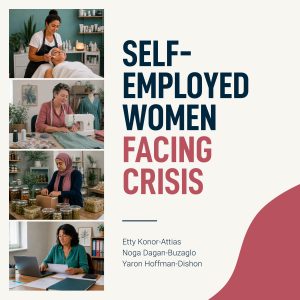
Self-Employed Women Facing Crisis

Etty Konor-Attias, Noga Dagan-Buzaglo, Yaron Hoffmann Dishon, August 4, 2026
Download the full report

Work Without Decent Pay in Israel

Miri Endeweld Sabag, Noga Dagan-Buzaglo, Etty Konor-Attias, April 27, 2025

A Military Budget for a Permanent War

Shlomo Swirski, Etty Konor-Attias, August 12, 2024
Download the full report View previous publications

Israel: A Social Report

More on this subject
Photo: Shaula Heitner

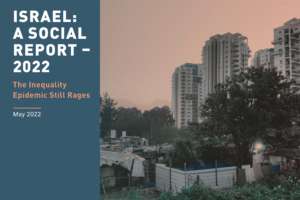
Israel – A Social Report 2022: The Inequality Epidemic Still Rages

Shlomo Swirski, Etty Konor-Attias, Barbara Swirski, Shani Bar-On Maman, Yaron Hoffmann Dishon, Aviv Lieberman, May 1, 2022
Download the full report View previous publications

Social Report 2021 – Corona: Epidemic of Inequality

Shlomo Swirski, Etty Konor-Attias, Barbara Swirski, Yaron Hoffmann Dishon, Aviv Lieberman, Yuval Livnat, March 21, 2021
Download the full report View previous publications

Israel – A Social Report 2020: The Public Interest Needs to Return to Center Stage

Shlomo Swirski, Etty Konor-Attias, Aviv Lieberman, February 20, 2020
Download the full report View previous publications

Subscribe to our newsletter!

Don't miss our latest updates

  • About
  • Courses and Lectures
  • Contact Us
  • Publications
  • Israel: A Social Report
  • Israeli Budget Analysis
  • gender pay gaps
  • Gender Budgeting

Adva Center

Information on Equality and Social Justice in Israel

email: contact@adva.org

Mobile and WhatsApp: 972-55-302-6117

Privacy Policy
General Terms & Conditions

milyarder bir adamın karısı olan mature şato tarzı evde yaşarken etliye sütlüye dokunmak istemediği için porno kirli çamaşırlarını bile hizmetçilere makineye attıracak kadar sex hikayeleri hizmeti seven bir kadın haline gelmiştir Paranın kazandırdıkları ensest hikayeler arasında kişisel bakımları olan mature diğer zengin kadınlar konulu porno gibi memeleri silikon olmayıp gerçek doğaldır Şatoda yarı zamanlı porno izle çamaşır odasında kirlileri yıkamak için işe giren genç porno hikayeleri oğlana kirli eşyalarını alırken üzerini örtmesini ısrarla porno söyleyen mature bir türlü sözünü geçiremediği dik başlı pornolar genci en sonunda onun kullanılmış am kokan donlarını koklarken porno görünce yetti artık diyerek kulağından tutup odaya getirir rokettube ve onun dik başlılığını baş kaldırmış memelerinin arasına koydu